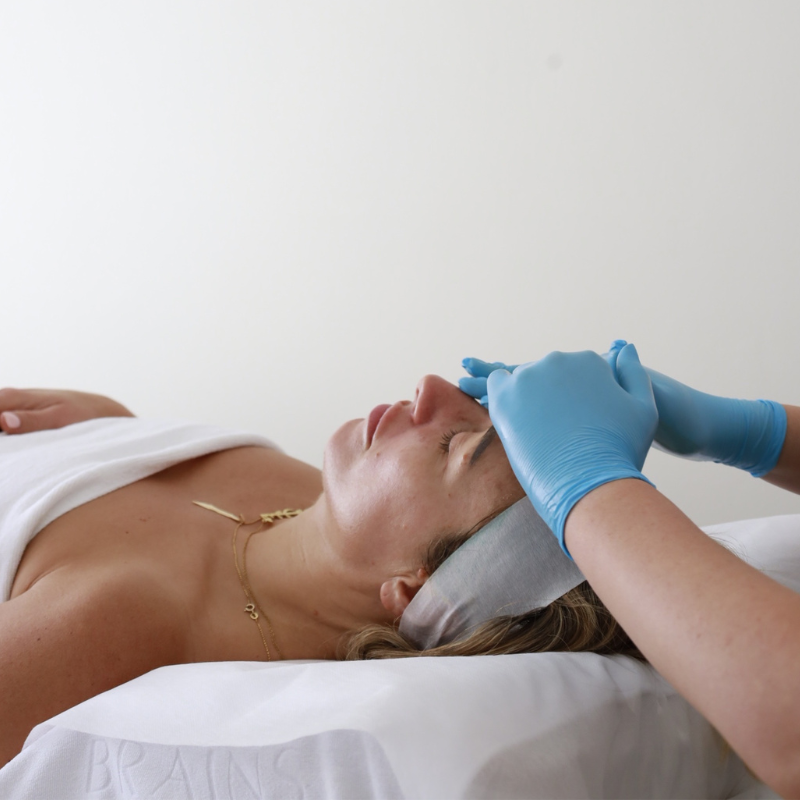
Restore Volume. Redefine Contour. Results That Feel Like You.
From your late 20s, the fat pads that give your face its natural fullness begin to shift and diminish. Combined with bone resorption and reduced collagen, this creates hollowing under the eyes, flattening of the cheeks, deepening lines around the mouth, and a loss of jawline definition.
Volume loss and skin laxity are related but distinct — and they require different approaches. At Brains Aesthetics, we use clinical imaging and facial mapping to identify what's actually driving the change before recommending any treatment.
- Hollow under eyes
- Flat or sunken cheeks
- Deepening nasolabial folds
- Loss of jawline definition
- Thinning lips
- Temple hollowing
- Skin changes after weight loss


Your questions about facial volume loss, answered.
What causes facial volume loss?
Facial volume loss occurs as the fat pads that give your face its natural fullness gradually diminish and shift with age. Combined with bone resorption and a decline in collagen, this creates hollowing under the eyes, flattening of the cheeks, deepening lines around the mouth, and a softening of the jawline. Volume loss tends to begin in the late 20s and becomes increasingly visible through the 30s, 40s, and beyond. The rate and pattern of change is influenced by genetics, weight fluctuations, hormonal status, and sun exposure.
What is the difference between facial volume loss and skin ageing?
They are related but distinct. Volume loss is the deflation of the structural fat pads and bone beneath the skin — creating hollowing, flattening, and a loss of contour. Skin ageing refers to the surface and structural changes in the skin itself — including reduced collagen, laxity, fine lines, and texture changes. Most patients over 40 experience both, but in different proportions. Accurately identifying the dominant driver matters because treating one when the other is primary will not produce the best outcome. This is the purpose of your clinical assessment at consultation.
What is the difference between facial volume loss and skin laxity?
Volume loss is the deflation of underlying fat and structural support — the face looks hollow, flat, or less defined. Skin laxity is loose or sagging skin caused by collagen and elastin breakdown. The two often occur together but require different treatment approaches. Adding volume to skin that primarily needs tightening — or tightening skin that primarily needs structural support — will not deliver the best result. Your clinician will assess both at consultation and identify what's driving the change.
Can weight loss cause facial volume loss?
Yes. Weight loss — including through GLP-1 medications such as Ozempic or Mounjaro — reduces the facial fat pads that provide structural support, particularly in the mid-cheek, temples, and under the eyes. The result is often hollowing and deflation before any tightening effect is visible. The degree of change depends on how much weight was lost, how quickly, and individual factors including age and skin elasticity. We offer a dedicated Skin Changes After Weight Loss consultation for patients experiencing facial changes following weight loss.
Choosing the right treatment
How do I know which treatment is right for me?
The right treatment depends on the type and degree of volume loss, your skin quality, age, hormonal status, weight history, and goals — none of which can be assessed without seeing your face. A complimentary 30-minute consultation with our team is the best first step. There is no obligation to proceed.
What treatments are available for facial volume loss?
Our primary approach to facial volume loss is through collagen biostimulation — injectable treatments that work by stimulating your skin to rebuild its own structural collagen over time. This is complemented where appropriate by skin quality boosters to support hydration and elasticity, and energy-based treatments such as Sofwave where skin laxity is also present. All injectable treatments are prescription medicines available only following clinical assessment and prescription by a qualified practitioner. The most appropriate combination for your presentation is discussed and recommended at your consultation.
What is collagen biostimulator and how does it work?
A collagen biostimulator is an injectable treatment that works by stimulating your skin to produce its own collagen over time — gradually rebuilding structural volume and firmness from within rather than filling with a gel-based substance. The result is a progressive, natural-looking improvement as new collagen forms over weeks and months. Collagen biostimulators are particularly suited to patients experiencing gradual structural loss who are looking for a long-lasting outcome that works with their own biology. As prescription medicines, they are only available following clinical consultation and prescription by a qualified practitioner.
How soon will I see results from volume restoration treatment?
Collagen biostimulators work progressively — the full effect develops over several weeks to months as your skin builds new collagen, with results continuing to improve after each session. This is not an instant result, and that is intentional — the gradual nature of the change is what makes it look natural. For patients on a staged plan, results from one session are assessed before the next is recommended. Your clinician will give you a realistic timeline at your consultation so you know what to expect and when.
How long do results last?
Non-surgical treatments are not permanent — and the natural ageing process continues after treatment. What collagen biostimulation does is raise your baseline. Your skin produces more of its own structural collagen, so while it will continue to age, it does so from a stronger foundation. The visible improvement does not simply disappear — over time, your skin gradually returns to where it would have been without treatment, rather than snapping back to its pre-treatment state. Ongoing maintenance helps sustain and build on that improved baseline. Specific longevity expectations for your presentation are discussed at consultation.
I've had filler treatments elsewhere. Does that affect my suitability?
Previous filler treatment is important information for your clinician to have, but it does not preclude you from care. At your consultation, your full treatment history will be discussed as part of your clinical assessment.
Natural results and suitability
What natural results mean to you at Brains Aesthetics?
To us, natural-looking means restoring what has been lost — not adding what was never there. Our approach starts with a thorough clinical assessment of your facial anatomy. Treatment is guided by your structure, not a template. We begin conservatively and reassess as results develop, always working with your face rather than imposing a look onto it. The goal is that you look like yourself — only rested, restored, and well. If a result would be noticeable to others before it looks refreshed to you, we haven't done our job.
Who is a suitable candidate for facial volume restoration?
Suitability is assessed individually at consultation. Good candidates are generally those experiencing visible hollowing, flattening, or loss of facial definition, with realistic expectations about what non-surgical treatment can achieve. Treatment may be deferred in cases of active infection, pregnancy, certain medications, nutritional deficiencies, or where structural change is beyond non-surgical limits. Your clinician will advise honestly on whether treatment is appropriate and what it can realistically deliver for your specific presentation.
Are these treatments safe?
All injectable treatments offered at Brains Aesthetics are prescription medicines regulated by the TGA in Australia. They are only legally available following clinical consultation, suitability assessment, and prescription by a qualified practitioner. All treatments are performed by experienced dermal clinicians and cosmetic nurses. As with any medical treatment, there are potential risks and side effects — these are discussed in full at your consultation and your informed consent is obtained before any treatment proceeds.